
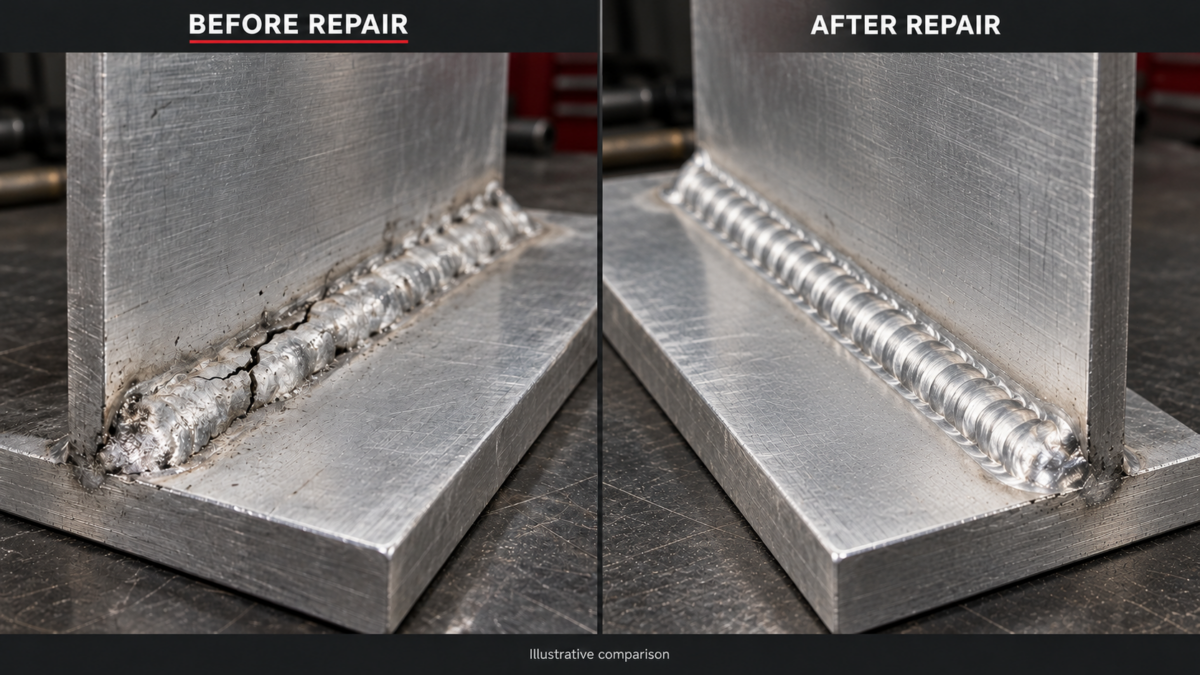
ALUMINUM WELDING & REPAIR
A crack in an aluminum part does not automatically mean it belongs in the scrap pile. But welding over the visible line is not enough to decide whether it is ready to work again.
Cracked aluminum repair starts with an assessment: what the part is made from, what caused it to fail, and what happens if it fails again. Those answers help determine whether welding, replacing a section, or replacing the entire component makes the most sense.
Can cracked aluminum be welded?
Many aluminum components can be repaired by welding. The answer for a particular part depends on its alloy, thickness, condition, crack location, accessibility, and intended use. A small crack in an accessible, otherwise sound fabrication is a different job from widespread cracking in a heavily loaded component.
Cast aluminum deserves particular attention. Unknown material, embedded contamination, and previous repair attempts can complicate the work. Photos are a useful starting point, but an in-person inspection may be needed before a welder can recommend a repair.
Why aluminum repair needs a specialist
Aluminum welding depends on careful preparation, compatible filler metal, effective shielding, and controlled heat input. Oxide, oil, moisture, and other contamination can undermine the weld. The surrounding metal also matters: welding can change the properties of the heat-affected zone, especially in heat-treated alloys.
TIG or MIG may be appropriate depending on the component and repair requirements. The best choice comes from the job, rather than a blanket claim that one process is always stronger. Learn more in our article on why aluminum welding requires a skilled hand.
Why a crack can come back
A crack is evidence of a problem, and the visible damage may be only part of it. Repeated flexing, vibration, impact, poor support, or an overloaded connection can continue stressing the area after welding. Simply adding more weld metal does not necessarily solve the cause.
A proper assessment considers the full extent of the damage and whether the original loading or design needs attention. Reinforcement is not automatically the answer either; changing stiffness can shift stress to another location.
Ask how the damage will be assessed, how the repair will be checked, and whether the original cause of failure can be addressed. Image shown as a weld example, not a documented cracked-part repair.
When replacement may be the better choice
Replacement may be more practical when damage is extensive, the material cannot be reliably identified, the repair is inaccessible, or the total repair cost approaches that of a suitable replacement. Repeated failures are another reason to reconsider the component rather than keep patching it.
For load-bearing, pressure-containing, road-going, or other safety-critical parts, follow the manufacturer's requirements and any applicable engineering or inspection requirements. A repaired part should not be assumed to retain its original rating solely because the crack has been welded.
What to send before requesting a repair
- A clear close-up of the crack and a wider photo of the whole component.
- Approximate dimensions and material thickness, if known.
- The equipment make, model, and alloy or material markings.
- How the part is used and when the crack appeared.
- Details of previous welds, patches, coatings, or leaks.
- Your location and whether the component can be removed.
Leave the damage visible for assessment and explain any cleaning or repair attempts already made. If failure could cause injury or further damage, take the equipment out of service until it has been evaluated.
Common questions about cracked aluminum repair
Can a welder guarantee an answer from a photo?
A photo can help screen the job, but it cannot reveal every crack, material condition, or access problem. Final recommendations may require inspection.
Is repair cheaper than replacement?
Sometimes. Compare the full cost, including removal, preparation, inspection, finishing, downtime, and reinstallation—not just the welding time.
Will the repaired area be as strong as new?
That cannot be promised for every component. Material properties, repair design, welding procedure, and service conditions determine what is achievable.
Have a cracked aluminum part?
Contact Stellar Welding to discuss your project. Share photos, the part's purpose, and your location so we can review the damage and discuss the next step.
Discuss Your Aluminum Repair →Technical reading: Miller: TIG welding aluminum for repair and American Welding Society: Aluminum Welding 101.